
How to walk more every day, without a streak to break
Most step apps start you at 10,000 steps and a streak counter. Neither was built for the week you get a cold, travel, or it rains for five days. This guide is the other approach: a goal that starts from where you already are, rises slowly, and treats a missed day as a missed day rather than a reset.
Start from your own week, not from 10,000
The 10,000-step target is older than the research behind it. It traces back to a pedometer sold in Japan in 1965 called the manpo-kei, which translates as "10,000-step meter". The number was a slogan for the device, and it stuck.
Studies since then point somewhere more forgiving. A 2022 meta-analysis of 15 cohorts covering about 47,000 adults found that the risk of death fell as daily steps rose, levelling off at roughly 6,000 to 8,000 steps a day for adults aged 60 and over, and 8,000 to 10,000 for younger adults. An earlier study of older women saw lower mortality from about 4,400 steps a day compared with 2,700, levelling off around 7,500.
Both are observational, so they show an association rather than proof. But they agree on the useful part: the biggest difference is between walking very little and walking somewhat more. If you average 3,000 steps today, 4,000 is a real step forward, not a failure to reach 10,000.
So begin with your actual number. On iPhone, open the Health app, tap Browse, then Activity, then Steps, and switch the chart to W. The average for the week is your starting point.
Add 500 steps, not 5,000
Five hundred steps is about five minutes of brisk walking. That is small enough to fit into almost any day, and it still adds up: a week of it is 3,500 extra steps, and the goal can rise again next week.
The rule that makes this work is to set each new goal from the week you just had, not from the goal you set last time:
- Take last week's daily average.
- Add 500. That is this week's goal.
- Next week, repeat with whatever you actually walked.
A good week nudges the goal up. A bad week brings it back within reach instead of leaving you further behind every day. You never end up chasing a number you set during your best month.
Make the extra steps easy to find
Extra steps come more reliably from small changes to things you already do than from a new workout you have to schedule:
- Take phone calls on your feet, or walking around the block.
- Get off one stop early, or park at the far end of the car park.
- Walk for ten minutes after dinner. At a brisk pace that is around 1,000 steps.
- Do one errand on foot each day instead of by car.
- Keep a short, fixed loop near home that you can walk without deciding anything.
- Use the stairs for one or two floors.
Pick one or two that fit your week rather than all of them. The goal is a habit that survives a busy day, not a perfect one.
Why a streak is a poor fit for walking
A streak counts consecutive days, so its whole value sits in never missing. That works for a habit that takes thirty seconds. Walking depends on weather, health, travel and how your legs feel, and all of those will eventually cost you a day.
When that happens, a streak does something odd: one missed day erases the record of all the days before it. Forty days of walking becomes zero. For many people that is exactly the moment they stop, because starting over at zero feels worse than not starting at all.
Measures that only ever grow avoid this. Your weekly average, total steps walked this month, or goals met so far all keep your progress when you miss a day, so the next walk adds to something rather than starting from nothing.
Plan for the bad week before it arrives
Every walking routine meets a week of illness, deadlines or bad weather. Deciding in advance what you will do then turns it from a collapse into a pause:
- If you are ill or injured, rest. Walking can wait, and the weekly reset will bring your goal back down to meet you.
- If it is the weather, a few laps of a shopping centre, a station concourse or your own hallway still count.
- If it is time, a single ten-minute walk keeps the habit alive even when the number is low.
The measure of a routine is how quickly you come back to it, not whether you ever miss.
How Pixfin is built around this
Pixfin is the step app we make at RJ Labs, and it follows the approach in this guide. Instead of a streak, you raise an aquatic creature: each step milestone you walk past grows it to its next life stage.
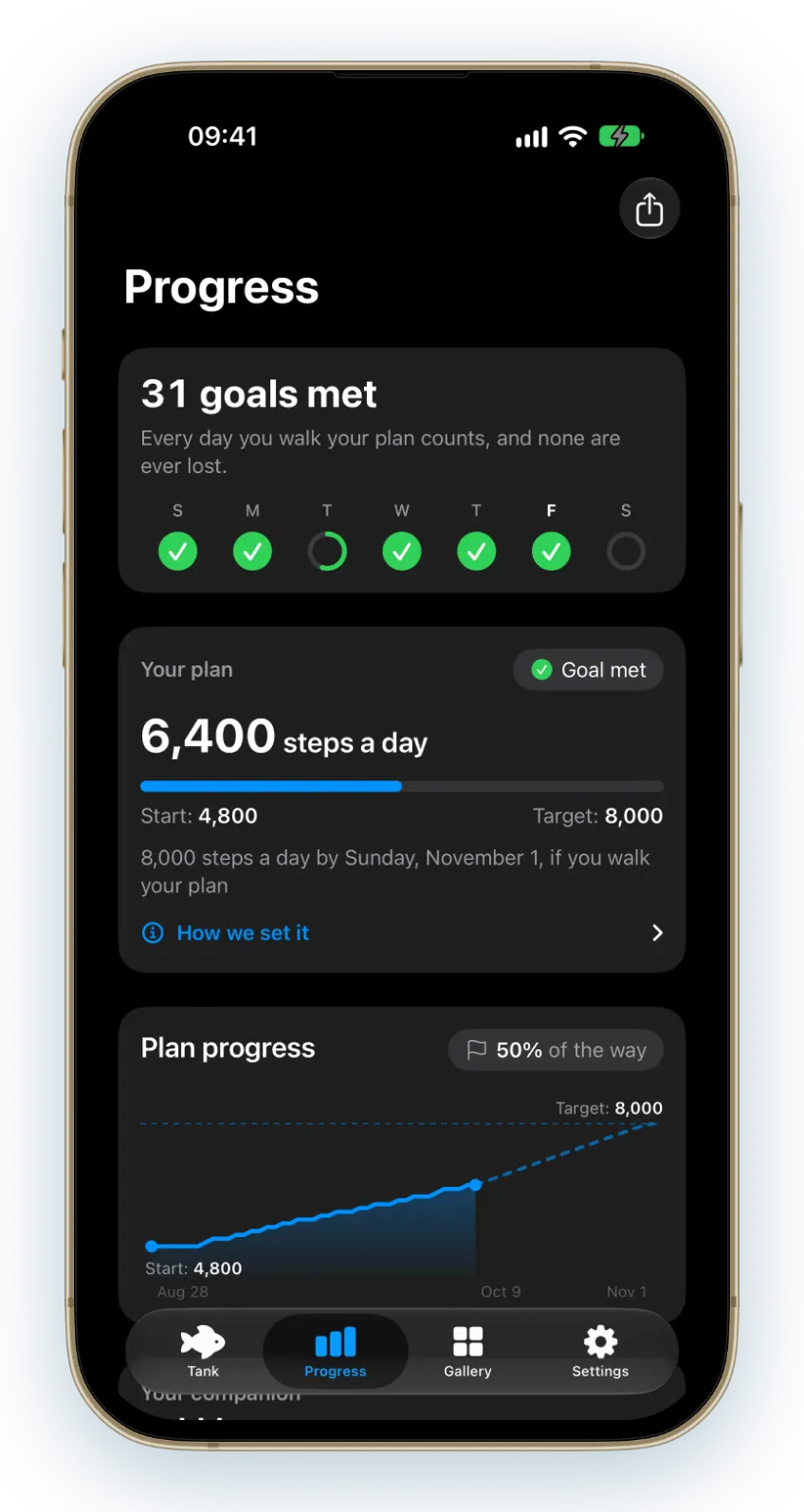
- Your daily goal is your own average over the previous seven days, plus 500 steps.
- A day that falls short is never marked as failed, and no progress is ever taken back.
- There is no streak counter, and nothing dies if you stop for a week or a month. Your creature waits where you left it.
- Steps come from Apple Health, so there is nothing to log. Pixfin reads step count only and writes nothing back.
- Grown creatures fill a gallery of 32 real species, so what you have walked stays visible.
Pixfin is for iPhone and iPad with an Apple Watch app, and requires iOS 26 or later. It is free to download, and using it takes a subscription, with a 7-day free trial on the yearly plan.

Common questions
How many steps a day should I walk?
Start with your own current average and add about 500. Research on adults links more daily steps with lower mortality up to roughly 6,000 to 8,000 steps for people aged 60 and over, and 8,000 to 10,000 for younger adults, but any increase from a low starting point counts.
Do I need to walk 10,000 steps a day?
No. The 10,000 figure began as a slogan for a 1965 Japanese pedometer, not as a research finding. Studies since have found benefits starting well below it.
How fast should I increase my daily steps?
About 500 steps a week is a sustainable pace for most people: roughly five extra minutes of walking a day. Set each week's goal from what you actually walked the week before, so a bad week lowers the bar instead of leaving you behind.
What should I do if I miss a day?
Nothing special. Walk the next day as normal. Track measures that keep your progress, such as your weekly average or goals met, rather than a streak that resets to zero.
Is there a step tracker without streaks?
Yes. Pixfin, for iPhone, iPad and Apple Watch, has no streak counter. Its daily goal is your own seven-day average plus 500 steps, a short day is never marked as failed, and walking grows a creature that never dies if you stop.
Sources
- Paluch AE et al. Daily steps and all-cause mortality: a meta-analysis of 15 international cohorts. The Lancet Public Health, 2022.
- Lee I-M et al. Association of step volume and intensity with all-cause mortality in older women. JAMA Internal Medicine, 2019.
This guide is general information, not medical advice. If you have a health condition or have not been active for a while, check with a doctor before changing how much you walk.